
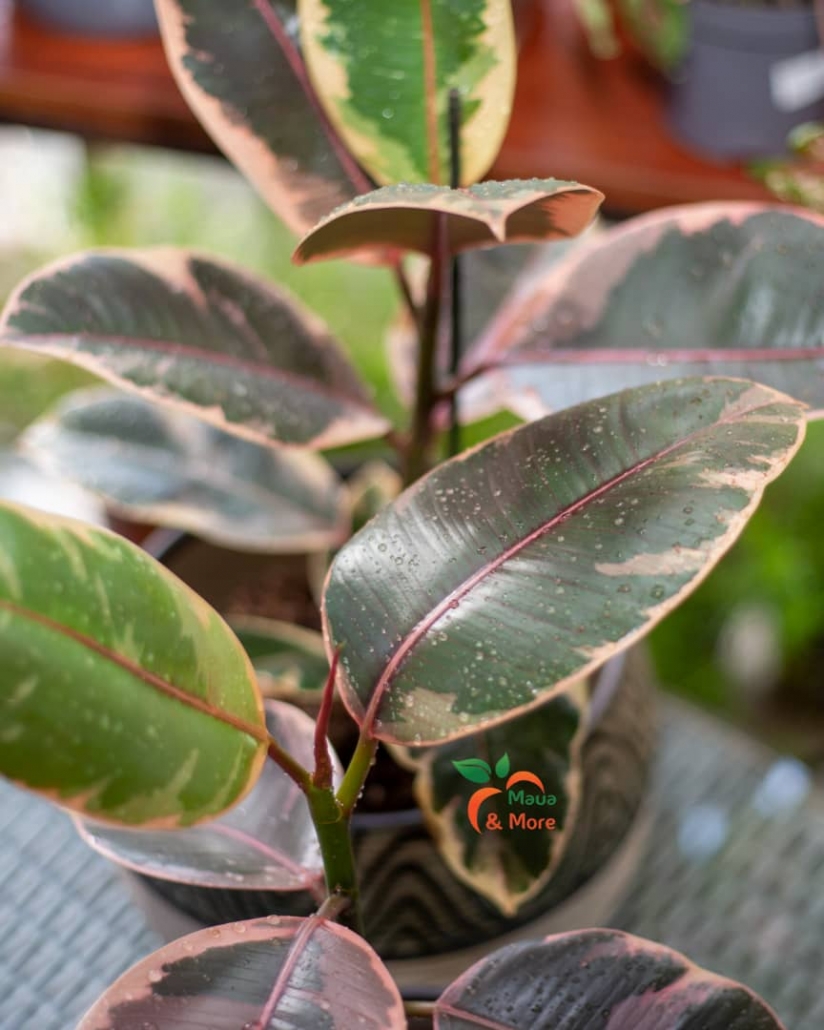
How to care for your Rubber Plant
This post shares everything you need to know about rubber plant care!
Rubber tree care is simple and rewarding; you can grow and beautiful plant for your home with very little work.
Back ground
Ficus elastica, the rubber fig, rubber bush, rubber tree, rubber plant, or Indian rubber bush, Indian rubber tree, is a species of flowering plants in the family Moraceae.
It has may Varieties as a family. At Maua And More we have the following varieties ;-
F. elastica “Tinike” whose leaves have unique patterns in shades of greens and creams, while it’s brother, F. elstaica “Robusta” has deep green leaves. F. elastica Rubra is deep marron and F. Elastica Tricolor has pink-toned leaves are sure to add impact.
Care
Light
Medium to bright indirect light.
Do rubber plants need direct sunlight?
No, a rubber plant does not need direct sunlight; instead, shoot for medium to bright indirect light. However, unlike many houseplants, they can tolerate some direct sunlight. But keep in mind that too much direct sunlight can cause the leaves to fade or scorch.
If the plant is getting too much light, the leaves may become pale or yellow. Slowly acclimate it to direct light to ensure it can build up its tolerance and not burn. Especially if you’re moving the plant outdoors
If the plant is not getting enough light, it may become leggy and the leaves may lose their color or drop from the plant completely. A leggy plant has stems that are longer than they should be and leaves that are smaller and farther apart than normal. This leads to a “leggy” look, as opposed to the full, lush look we associate with healthy plants.
Water
Let the top soil dry to touch.
How often should you water a rubber plant?
Like other common household plants, rubber plants don’t require a lot of water. I recommend allowing the soil to dry out slightly between waterings. A good rule of thumb is to water the plant once a week after the several inches or so of soil feels dry. Just stick your finger in or use a moisture meter to see.
In general, rubber plants prefer to be kept evenly moist but not waterlogged. Overwatering can lead to root rot and sometimes yellowing leaves, while underwatering can cause the leaves to droop and turn yellow. Don’t worry you occasionally lose an older leaf. I’ve had this plant for many years and have found that it is normal for it to occasionally kill off an older leaf and drop it.
Cleaning rubber plant leaves
Like any other houseplant, a rubber plant also needs light and carbon dioxide for the process of photosynthesis.
Using this process, rubber plants take in carbon dioxide and sunlight from their leaves to produce sugar and oxygen. The sugar is then used as a source of energy, and oxygen is released into the atmosphere.
But what does this have to do with cleaning the leaves of your rubber plant?
As the layer of dust or grime buildup on the leaves’ surface, the plant starts to struggle while exchanging gases and absorbing sunlight. That can result in slow growth.
- Spray your plant with plain water .
- Get water in any container then Add a little liquid soap mixing evenly
- Get a towel or cotton piece of cloth and use the soap water to clean and dry the leaves .
These leaves are total dust magnets, so the cleaning is totally worth it! The plant looks so lovely afterward.
How large does a ficus elastica grow?
Rubber plants can grow to be quite large under the right conditions. In its natural habitat, it can grow up to 100 feet tall, but it is typically much smaller when grown as a houseplant. Rubber plants grow slowly, so it may take several years for them to reach their full size.
Pest issues & how to spot them
Normal household plant pets can infest the rubber tree but they aren’t especially vulnerable. Look for signs of these pests on your plant during routine pest inspections. Catching them early is key to getting rid of them fast!
- Aphids: Small, pear-shaped insects often found on the undersides of leaves and on new growth. They feed by sucking sap from the plant, which can cause stunted growth and yellowing.
- Scale: Small insects that can be found on the stems and leaves. Look for yellowing leaves and sticky residue on or around the plants.
- Mealybugs: Small, white insects that secrete a waxy substance that can coat the leaves and stems of the plant. They feed by sucking the sap from the plant, which can cause yellowing and wilting.
- Spider mites :Tiny spider-like insects can be found on the undersides of leaves. Look for fine webbing, especially around the area where the leaves meet the stem and on the leaf tips.
- If you notice any of these pests on your rubber plant, you can try removing them by hand or using a mild soap solution. If the infestation is severe, you may need to considering using an insecticide spray.Also note that rubber plants can develop sooty mold, which is a black dusty mold that can grow on leaves. Remove it by wiping the leaves with a diluted dish soap mixture, and avoid letting moisture sit on the leaves in the future.


Leave a Reply
Want to join the discussion?Feel free to contribute!